Oven and Range Repair in Palm Desert Guide: Repair vs. Replace
When Should You Opt for Oven and Range Repair in Palm Desert Instead of Getting a Replacement?
As an industry rule of thumb, you should opt for oven and range repair in Palm Desert if the cost of the repair is less than 50% of the cost of a comparable new appliance and the unit has completed less than half to two-thirds of its expected operating life. Standard gas ranges last 15 to 18 years, electric units last 13 to 15 years, and luxury professional platforms (Wolf, Viking, Thermador, Dacor) regularly exceed 20 to 25 years. Most sudden failures—such as weak silicon carbide igniters, burned bake elements, or failed spark switches—are isolated, low-cost component fixes. Replacement is warranted only when structural chassis integrity fails (rusted or breached oven cavities), proprietary control boards are discontinued, or cumulative repair costs exceed 50% of buying and custom-fitting a replacement.
When a primary cooking appliance fails in the middle of preparing dinner or right before entertaining guests, homeowners across the Coachella Valley face an immediate financial and logistical question: is it smarter to schedule a repair or replace the unit entirely?
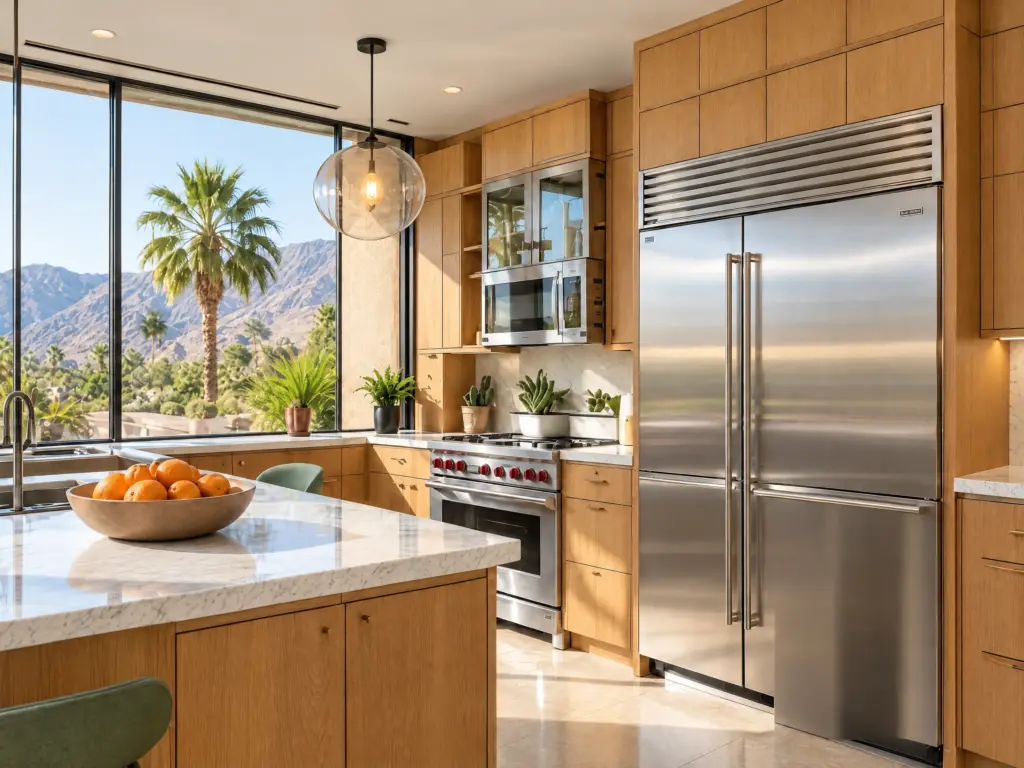
In the desert communities of Palm Springs, Rancho Mirage, Palm Desert, and Indian Wells, kitchen cooking setups rarely use cheap, freestanding drop-in appliances. Instead, homes often feature commercial-depth pro ranges, custom integrated wall ovens, and architectural induction cooktops recessed into solid slab counters and custom architectural millwork.
In these high-end installations, replacing an oven is almost never as simple as unplugging an old box and sliding in a new one. Differences in electrical infrastructure, ventilation duct geometry, cabinetry cutouts, and desert utility dynamics turn simple replacements into multi-thousand-dollar home renovation projects.
Evaluating the financial mechanics of range repair versus replacement helps protect your home equity, preserves your kitchen’s architectural integrity, and avoids unnecessary capital expenses.

The 50% Rule: Appliance Longevity and Financial Math
The appliance service industry evaluates equipment viability using the 50% Rule: if a targeted repair costs less than 50% of the retail price of an equivalent brand-new replacement, and the machine has consumed less than half of its realistic service life, restorative repair is the economically superior decision.
Calculating this equation requires knowing the true lifespan benchmarks of modern cooking appliances, rather than the shortened 7- to 10-year timelines often cited for entry-level builder-grade inventory.
True Appliance Lifespans by Fuel and Design Category
- Commercial Pro-Style Ranges (Wolf, Viking, Thermador, Monogram): 20 to 25+ years. Built with heavy-gauge stainless steel chassis, industrial gas valves, and modular, serviceable wiring harnesses.
- Residential Gas Ranges & Cooktops: 15 to 18 years. Gas burner assemblies and mechanical safety valves experience very little operational degradation over time.
- Built-In Electric Wall Ovens: 13 to 16 years. Heavy insulation and solid relay boards give these units long operational runways when properly ventilated.
- Radiant Electric & Glass Induction Cooktops: 12 to 15 years. Solid-state induction generator boards and surface coil assemblies remain reliable as long as internal cooling fans operate unimpeded.
If an eight-year-old high-end dual-fuel range requires a replacement spark module, or a six-year-old double wall oven needs a new convection element and cooling fan, you are well within the profitable repair zone. Comprehensive oven, stove, and range repair restores exact factory specifications for a fraction of the cost of acquiring and retrofitting new hardware.
The Built-In Replacement Trap: Hidden Costs in Desert Homes
In custom communities throughout La Quinta, Bermuda Dunes, and Cathedral City, kitchens are engineered with precision around specific appliance dimensions. Homeowners who assume that purchasing a new 30-inch, 36-inch, or 48-inch range will result in a simple swap frequently encounter the “built-in replacement trap.”
Swapping out built-in cooking equipment introduces several secondary logistical costs that often run higher than the price of the appliance itself.
1. Architectural Cabinetry and Countertop Retrofitting
Standard nominal appliance widths (such as 30″, 36″, or 48″) refer only to the exterior face dimensions. Rough-in cabinet cutouts, interior depth clearances, toe-kick heights, and side-reveal bevels differ between manufacturers and even across different generations of the same brand.
Installing a modern wall oven into a custom walnut or white oak opening frequently requires precision on-site millwork, re-staining, and cutting solid quartzite or granite countertops. In custom homes across the Coachella Valley, secondary carpentry and masonry modifications routinely cost between $1,200 and $3,500 over the retail price of the new appliance.
2. High-Amperage Electrical Service Modifications
Upgrading from a traditional radiant electric top or gas range to a high-efficiency magnetic induction cooktop requires substantial electrical capacity. Induction cooktops utilize dual- or quad-generator modules that demand dedicated 40-amp or 50-amp, 240-volt branch circuits with individual neutral and ground lines.
Older homes in mid-century Palm Springs neighborhoods or mature country clubs frequently have 100-amp or 150-amp main electrical panels that lack available breaker spaces, necessitating subpanel installations or main service panel upgrades that can add thousands to the project.
3. California Environmental and Local Title 24 Energy Compliance
Replacing gas cooking equipment in California involves strict compliance with regional emissions policies, South Coast Air Quality Management District (SCAQMD) requirements, and California Title 24 makeup air regulations. If a replacement pro-style range features high-output burners exceeding 60,000 total BTUs, local municipal codes often mandate an accompanying commercial-grade ventilation hood with dedicated, interlocked makeup air dampers.
Furthermore, hauling away heavy insulated ranges requires adherence to California electronic waste disposal and scrap metal processing protocols.
Coachella Valley Microclimates: Environmental Wear on Cooking Appliances
Operating kitchen cooking equipment in the low desert environment introduces distinct mechanical and thermal stresses that do not affect coastal or temperate climates.
Understanding these hyper-local microclimate factors explains why certain oven and cooktop components fail prematurely, and why a targeted component replacement is often more sensible than buying another unit that will face the same environmental stress.
During Coachella Valley summers, high ambient outdoor temperatures mean indoor air conditioning units run continuously. High-load refrigeration and cooling systems place continuous demand on the local electrical grid, causing micro-surges and brownouts that can stress sensitive oven control boards, relays, and surface display modules.
Additionally, fine particulate matter from seasonal wind events moving through the San Gorgonio Pass settles into gas burner throat tubes and air shutters, disturbing the fuel-to-air combustion mixture. This causes lazy yellow flames, soot buildup, and incomplete ignition. Addressing these issues requires professional cleaning and component recalibration rather than an expensive equipment replacement.
4 Common Oven & Cooktop Malfunctions: Technical Verdicts
Most cooktop and oven breakdowns stem from individual electro-mechanical components reaching the end of their operational cycles, rather than a failure of the overall chassis or oven cavity. The table below outlines common symptoms, their underlying mechanical causes, and the recommended service path.
| Symptom & Malfunction Profile | Technical Cause | Mechanical Process | Actionable Verdict |
| Oven Takes 40+ Minutes to Reach 350°F | Degraded Silicon Carbide Igniter or Open Element | Hot-surface igniters drop in electrical resistance (amperage draw falls below 3.2A–3.6A threshold), preventing the bi-metal safety valve from opening fully. In electric units, the lower bake loop has an open circuit. | Repair. Replacing a standard glow-bar igniter or tubular calrod element is straightforward and completely restores factory preheat cycle times. |
| Gas Burner Clicks Continuously Without Catching | Contaminated Electrode or Failing Spark Module | Moisture, grease, or carbon dust creates an electrical bridge to ground, or internal module capacitors leak voltage, causing erratic high-voltage pulse generation. | Repair. Disassembling burner heads, cleaning micro-orifices, or wiring in a new solid-state spark module resolves the failure cleanly. |
| Oven Temperature Fluctuates 50°F+ Above/Below Target | Out-of-Tolerance Platinum RTD Sensor | The oven temperature sensor (Resistive Temperature Detector) experiences thermal drift, reporting incorrect resistance values (normal: ~1,090 ohms at 75°F room temp) to the main controller. | Repair. Swapping the internal sensor probe takes minimal time and eliminates temperature swings without changing the appliance. |
| Blank Control Interface or Recurring Error Codes (F-Codes) | Thermally Damaged Board or Tripped Thermal Cutoff | Radiated oven heat damages power supply solder joints on the main relay board, or a high-limit thermal safety fuse blows during a self-clean cycle to prevent a fire. | Repair. Certified field technicians can replace logic boards, swap relays, or reset high-limit safety cutoffs without replacing the range. |
Single-Source Certified Service vs. Broker Warranty Dispatch Models
When deciding to invest in a repair, who you hire to diagnose the machine is just as critical as the components being replaced.
Homeowners looking for appliance repair in Palm Springs and Rancho Mirage often navigate two different service avenues: working with a local, single-source service provider, or relying on third-party broker dispatch networks arranged by national home warranty call centers.
Entrusting high-end, pro-style cooking suites to dynamic sub-contractor broker networks often leads to incorrect diagnoses, generic universal parts installations, and long delays waiting for approval tickets.
Working with established, factory-trained professionals ensures that specialized features—such as dual-stacked sealed brass burners, infrared broil elements, and hydraulic door hinges—are serviced using genuine OEM components that preserve your manufacturer warranty.
For dependable diagnostics, transparent pricing, and honest evaluations of your cooking setup, partner with a team backed by decades of proven home appliance repair (for services such as refrigerator repair) across the entire Coachella Valley.
Step-by-Step Field Diagnostic Procedure: How Technicians Evaluate Your Unit
When an experienced technician evaluates an oven or cooktop that is not heating, they follow a systematic diagnostic process to identify the issue without unnecessary component replacements.
- Supply Infrastructure Verification: The technician first verifies the energy source under load. For electric and dual-fuel units, this means testing leg-to-leg voltage at the terminal block (240 volts AC) and checking for line sags. For gas units, static and dynamic gas supply pressures are checked with a digital manometer to rule out clogged regulators or compromised gas supply valves.
- Safety Circuit Continuity Tracing: The technician tests the continuity of inline thermal safety fuses, high-limit thermostats, and door latch switches. If an oven experienced extreme thermal retention during a self-cleaning cycle, a tripped high-limit thermal switch will cut power to the heating circuit while leaving the digital clock lit.
- Sensor and Component-Level Testing: The technician disconnects the internal RTD sensor harness and reads its resistance with a digital multimeter calibrated to ohms. Next, for gas units, they measure the live current draw of the igniter using a clamp meter. If the igniter glows cherry red but draws only 2.6 amps, it cannot generate the electrical draw required to open the bi-metal gas safety valve (which requires 3.2 to 3.6 amps).
- Relay Board Logic Execution: If the sensors, safety fuses, and heating components show normal readings, the technician tests the logic outputs on the main electronic control board (PCB). By tracking line-voltage relays as the unit calls for heat, the technician determines whether the control board is delivering power to the heating circuits or if stuck relays and damaged solder points require a board rebuild or swap.
When Is Replacement the Right Choice?
While precision-engineered cooking platforms are usually worth repairing, there are specific scenarios where replacing the appliance is the more sensible technical and economic choice.
1. Structural Cavity Breaches and Frame Corrosion
If an oven cavity has rusted through, or the primary porcelain enamel finish has chipped down to bare steel and oxidized inside the bake zone, the unit’s thermal containment is compromised. Heat leaks through the inner walls can burn wiring harnesses, melt insulation, and create structural fire hazards within surrounding cabinetry. Cavity structural degradation cannot be safely patched.
2. Discontinued Proprietary Logic Boards
If your appliance is 18 to 22 years old and the manufacturer has permanently discontinued its main microcomputer board, touchpad membrane, or specialized safety valves, reliable repairs may no longer be possible. While third-party rebuilders can repair some circuit boards, severe board damage or shattered proprietary touch-glass interfaces often leave replacement as the only dependable path.
3. Cascading Multi-System Failures
When an older appliance suffers several major component failures simultaneously—such as a shorted control board that damages the main wiring harness, paired with weak burners and failed door hinge receivers—the combined cost of parts and labor can quickly pass the 50% threshold. In these cases, investing in a new cooking platform makes more financial sense.
Frequently Asked Questions About Oven and Cooktop Repair in Palm Desert
Is it worth fixing an oven that is 10 to 12 years old?
Yes, it is usually worth fixing a 10- to 12-year-old oven, particularly if it is a built-in wall unit or a pro-style range from brands like Wolf, Viking, Thermador, Dacor, or Miele. These platforms have structural lifespans of 20 or more years. Common problems at the 10-year mark—such as burned bake elements, weak glow-bar igniters, or worn door hinges—can usually be repaired for a fraction of the cost of buying a new unit and modifying your cabinetry. If the oven cavity is intact and replacement parts are available, repairing the appliance is almost always the smarter financial choice.
Why does my gas range burner click continuously even after the flame lights?
Continuous spark clicking occurs when the spark module fails to receive a micro-amp confirmation signal that the flame has lit. Most modern gas cooktops use flame rectification, meaning the burner flame conducts a low-voltage electrical current between the electrode and the metal burner base to confirm ignition.
If the burner ports are clogged with grease, the igniter electrode is coated in cooking residues, or high summer humidity introduces moisture beneath the burner housing, the system cannot verify the flame. The spark module continues firing as a safety measure. Thoroughly cleaning the burner head channels with a stiff nylon brush, drying the electrode, and checking the chassis ground wire will usually resolve the issue.
How do I determine if my oven temperature sensor has drifted out of calibration?
You can confirm temperature sensor drift by placing a calibrated analog oven thermometer or a digital thermocouple probe on the center rack of your oven. Set the oven to bake at 350°F and allow it to complete at least three full preheat and cycling steps over 45 minutes to normalize radiant wall temperatures. Record the temperature peaks and valleys across each cycle; the average reading should fall within 335°F to 365°F.
If the calculated running average deviates by more than 35°F to 50°F from your set temperature, the internal platinum RTD sensor has drifted out of resistance calibration. A technician can test the sensor with a multimeter: at room temperature (75°F), a standard RTD sensor should measure approximately 1,080 to 1,090 ohms. If the reading is open or significantly off-spec, swapping out the sensor restores accurate temperature regulation.
Can an oven control board damaged by desert heat or power surges be fixed?
Yes. A dead display, unclickable buttons, or erratic error codes (such as F1, F3, or F9 codes) do not always mean you need an entirely new appliance. Certified technicians can isolate whether the problem is a blown onboard fuse, a tripped high-limit thermal switch, or thermal fatigue on the control board’s line-voltage relays.
Even if the original equipment manufacturer has discontinued the board, specialized component-level technicians can often rebuild the circuit board by replacing damaged capacitors, reflowing solder joints, and replacing relays. This approach saves homeowners the significant expense of custom cabinet modifications and new appliance installations.